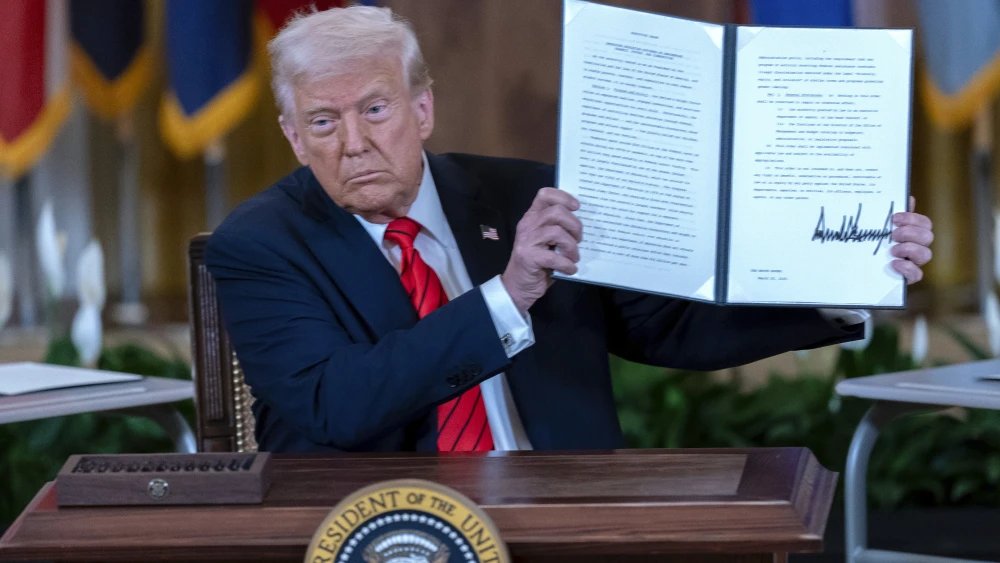
Trump AI Executive Order June 2026 – On June 2, 2026, President Trump signed an executive order on artificial intelligence — the one he had refused to sign just twelve days earlier. The version he ultimately put his name to is narrower, softer, and deliberately voluntary. Critics called it “on the verge of meaningless.” The tech industry largely welcomed it. And the AI regulatory debate — the most consequential policy argument in technology since the internet — moved forward by approximately one half-step.
Here is exactly what happened, what the order does, what was stripped out of it, and why it matters for investors watching OpenAI, Anthropic, Google, and the rest of the frontier AI landscape.
The Timeline: How a “Tough” Order Became a Voluntary Framework
- May 21, 2026: Trump refuses to sign an earlier draft of the AI oversight order, stating: “We’re leading China, we’re leading everybody, and I don’t want to do anything that’s going to get in the way.” The White House declines to elaborate on which specific provisions concerned the President.
- Late May 2026: Politico reports the draft order had been pre-reviewed by OpenAI, Anthropic, and Google before reaching Trump’s desk. Industry objections — particularly around mandatory review timelines and potential competitive disclosure risks — are incorporated into a revised version.
- June 2, 2026: Trump signs the revised executive order. The key change from the rejected May 21 draft: mandatory pre-release government review becomes voluntary.
- Week of June 8, 2026: Sam Altman of OpenAI meets with Senator Bernie Sanders and uses the occasion to publish a more detailed blueprint for AI regulation — positioning OpenAI as the constructive industry partner in whatever regulatory framework emerges next.
What the Trump AI Executive Order Actually Does
The signed order is structured around five operational pillars:
| Provision | Mechanism | Binding? |
|---|---|---|
| Pre-release government review of advanced AI | 30-day voluntary window | No |
| National security risk vetting | Companies invite government to test | Voluntary |
| Cybersecurity clearinghouse | Agencies share vulnerability info | Partially |
| Benchmarking framework | AI systems tested against cyberattack scenarios | Yes (framework only) |
| Federal agency AI security prep | Strengthens infrastructure for AI-caused vulnerabilities | Yes |
The core mechanism in plain English: Before releasing a new frontier AI model, companies can invite the government in for 30 days to probe for national security risks. The government can accept. Neither side is required to do anything. The order explicitly states: “nothing in this section shall be construed to authorize the creation of a mandatory governmental” — the sentence ends there in published versions, but the intent is unambiguous.
Why it Scaled Back: The Anthropic Catalyst
The trigger for the order — in whatever form — was a specific incident that alarmed security officials across Silicon Valley and Washington:
- Anthropic announced in April 2026 that it was limiting the release of Claude Mythos Preview — its most advanced model — because of its demonstrated ability to identify and exploit software security vulnerabilities at a level that prompted internal safety concerns
- Anthropic’s disclosure that a frontier model had capabilities serious enough to warrant restricted deployment “set off alarm bells” across the federal government, per NPR
- This was the moment the Trump administration — which had spent 16 months in a hands-off posture on AI — reversed course and began pushing for some form of pre-release visibility into the most powerful models
The administration’s conclusion was not that AI needed to slow down. It was that the government needed a window into what was coming — hence the 30-day voluntary review framework.
What Was Stripped Out
The gap between the May 21 rejected draft and the June 2 signed version is where critics are focused:
- Mandatory vs. voluntary: The most consequential change. A mandatory 30-day hold on releases of frontier models would give the government real leverage. A voluntary 30-day invitation gives them a polite knock on the door.
- No enforcement mechanism: The signed order creates no penalties, no triggers, and no consequences for companies that decline to participate in pre-release review.
- No definition of “advanced AI”: The order does not define which systems trigger the review window, leaving determination to future agency rulemaking that may never materialize.
- No mandatory safety test disclosure: Biden’s 2023 executive order — which Trump revoked on his first day back in office — required leading AI companies to share safety test results with the federal government. The June 2 order does not reinstate this requirement.
J.B. Branch, counsel for AI governance at Public Citizen, told MarketWatch the provisions were “on the verge of meaningless.” The watchdog added: “Models powerful enough to threaten cybersecurity and national security warrant real oversight.”
What the Tech Industry Said — and Didn’t Say
- OpenAI: Broadly supportive. Sam Altman used the order as a platform to publish his own, more detailed regulatory blueprint the following week — positioning OpenAI as the good-faith industry actor willing to engage with oversight
- Google and Anthropic: Pre-reviewed the draft (per Politico); neither issued a strong objection to the final signed version — which is itself evidence that the final version was acceptable to the companies with the most to lose from real mandatory oversight
- Anthropic complication: The company remains in an adversarial relationship with the Trump administration after the White House ordered all federal agencies to cease using Anthropic technology in February 2026; Anthropic is also not participating in the separate AI equity stake negotiations. The executive order creates an awkward situation: Anthropic’s Claude Mythos Preview was the proximate catalyst for the order, but the company is functionally excluded from the administration’s AI partnerships
What It Means for AI Investors
For investors, the executive order is less a regulatory event than a directional signal — and the direction is cautious deceleration of oversight, not acceleration:
Bullish reads:
- Voluntary framework means no mandatory compliance cost for AI companies
- No product-launch delays required by law
- Government engagement signals AI is now a national security asset — not just a risk to manage
- The order explicitly frames the goal as maintaining “U.S. leadership in AI innovation” — safety as a complement to competitiveness, not a constraint
Bearish reads / risks:
- The voluntary nature means the framework could collapse the moment one major lab declines to participate and faces no consequence
- Without enforcement, the “cybersecurity clearinghouse” is an information-sharing aspiration, not an infrastructure
- Congress is beginning to move independently — Republican Rep. proposals for AI legislation could produce something far more prescriptive than the executive order, creating genuine regulatory uncertainty
- The Anthropic-Trump federal exclusion creates a two-tier AI policy environment: companies inside the administration’s goodwill network (OpenAI, Google) and those outside (Anthropic) — a market structure distortion with real implications for federal AI contracts
Alondra Nelson of the Institute for Advanced Study put it most precisely: “What we are seeing from the White House, from OpenAI, and now from Congress is a convergence around a narrow vision of AI regulation focused on national security and frontier model safety.”
That narrow vision, she argues, leaves out the vast majority of AI’s social and economic impacts. Bias, labor displacement, information integrity. That affect everyday people far more directly than whether a frontier model can exploit a government computer.
The Bigger Picture: Where AI Regulation Goes From Here
The executive order’s best understood not as an endpoint. But as the opening move in what will become a sustained and increasingly consequential regulatory debate:
- Congressional action: Bipartisan interest in AI safety legislation is growing. With members from both parties citing the Anthropic Mythos incident as evidence that voluntary frameworks aren’t sufficient
- Government equity talks: Trump is simultaneously negotiating with OpenAI about the U.S. government taking an equity stake in the company. A structure that would make Washington a financial partner in, not just a regulator of, frontier AI.
- NIST and CISA role: The “cybersecurity clearinghouse” created by the order routes through existing federal agencies. The quality of implementation depends entirely on which agency leads and how much funding Congress allocates
For investors in AI-adjacent public companies — NVDA, MSFT, GOOGL, AMZN — the near-term verdict is clear: the regulatory environment remains favorable. No new mandates, no new compliance costs, no product-launch moratoria. The long-term picture is more uncertain, and the gap between a voluntary framework and real oversight will narrow. The only question is how fast, and under what political conditions.
Disclaimer: This publication is entirely for informational and journalistic purposes and does not constitute formal financial, investment, or legal advice. All market investments carry inherent risks of capital loss. Always complete independent due diligence prior to executing equity trades. Consult a qualified financial professional before making any investment decisions.
Follow TNN for daily economy news and latest financial news today!
Sources: Geo.tv Trump AI EO Explained, NPR AI Safety Order, TechCrunch Narrower EO, ms.now Public Citizen Criticism. CS Monitor AI Oversight Ending, Bloomberg Biden AI Order Revoked, Geo.tv Claude Mythos.
About The Author
