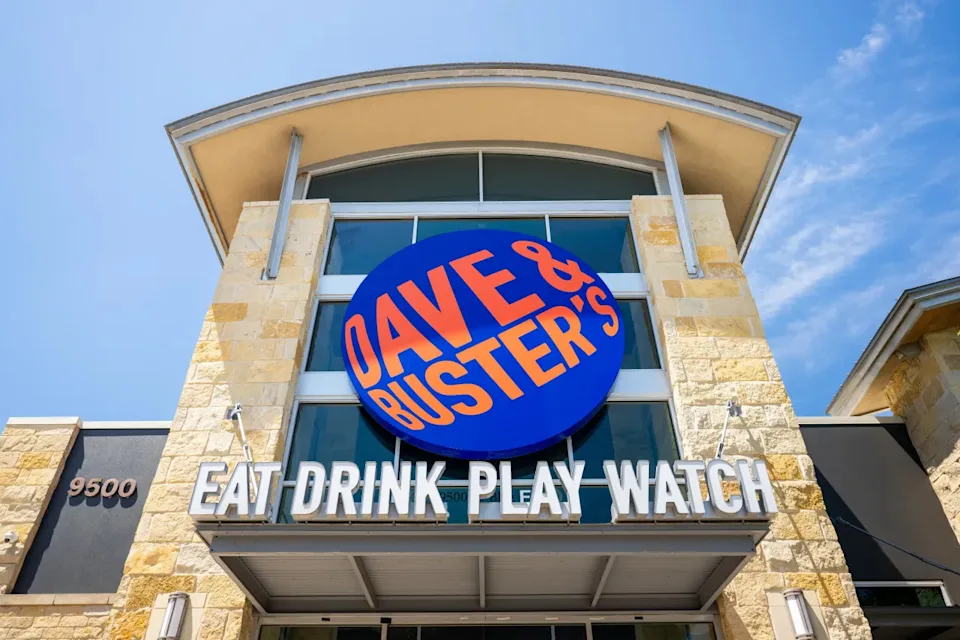
Dave & Buster’s (Nasdaq: PLAY) just served investors the worst meal of the year — and they’re not happy about it. After closing at approximately $12.30 on Friday June 13 heading into an earnings event that options markets priced for a ±13.7% move, PLAY stock delivered a double miss on June 15 after the close: revenue missed by $19M, EPS missed by 73%, and same-store sales dropped 5.4% in a quarter where every comparable leisure company had broadly stable comps. The stock fell 18.02% to $10.10 on Tuesday — crashing through its $9.61 52-week low support zone. Benchmark downgraded it. Patient Capital cut its position by 31%. And yet the CEO insists “the right strategy, the right team, and the right momentum” are in place. Here is the full picture.
PLAY Stock Snapshot (June 16, 2026)
| Metric | Value |
|---|---|
| Stock Price (June 16, during session) | $10.10 (-18.02%) |
| Prior Close (June 15) | ~$12.30 |
| Q1 Earnings Report Date | June 15, 2026 (after close) |
| 52-Week Low (pre-earnings) | $9.61 |
| 52-Week High | $35.53 |
| Market Cap (at $10.10) | ~$351 million |
| Shares Outstanding | 34,739,407 |
| Quarterly Dividend | $0.16 per share |
| Options Implied Move (pre-earnings) | ±13.7% |
| Actual Post-Earnings Move | -18.02% (exceeded implied) |
| Next Earnings Date (Q2 FY2026) | ~September 2026 (est.) |
| Hold Avg. Analyst Price Target | $14.67 |
The damage: A stock that traded above $35 twelve months ago is now below $11 — a 69% decline from 52-week highs. Management must demonstrate Q2 and Q3 comparable sales improvement or risk further institutional exodus.
PLAY Stock Q1 FY2026 Earnings: The Full Damage Assessment
Dave & Buster’s reported Q1 FY2026 results on June 15, 2026, after the market close. The numbers confirmed what many feared:
| Metric | Q1 FY2026 Actual | Consensus Est. | YoY |
|---|---|---|---|
| Revenue | $559.2M | $578.38M | -1.5% |
| Gross Profit | $479.4M | — | -1.3% |
| Operating Profit | $46.9M | — | -25.8% |
| Net Income (Attributable) | $5.7M | — | -73.7% |
| Diluted EPS (GAAP) | $0.16 | $0.598 est. | Miss: -$0.438 |
| Adjusted EPS | $0.22 | $0.66 consensus | Miss: -$0.44 |
| Comparable Store Sales | -5.4% | Flat/slight decline expected | Significant miss |
| Revenue Miss vs. Consensus | -$19.18M | — | -3.3% |
| EPS Miss vs. Consensus | -$0.438 | — | -73.2% |
The number that stings most: Comparable store sales of -5.4% in Q1 2026 against the same calendar period last year. In Q1 2025, comp sales were already declining — and now they’ve fallen further. That is two years of consecutive same-store deterioration.
Cash flow bright spot: Cash from operations showed stronger generation than implied by the income statement, and management reiterated the “over $100 million in free cash flow” target for fiscal 2026. This is the one number keeping value investors at the table.
What Management Said — and Why the Market Doesn’t Believe It Yet
CEO Tarun Lal on the Q1 2026 call:
“While first quarter results fell short of expectations, our back-to-basics strategy is gaining clear traction. We are driving meaningful progress across food and beverage, marketing, and our refreshed remodel program, which are delivering a sharper value proposition and driving a stronger guest experience. We have the right strategy, the right team, and the right momentum, and we are highly confident in our ability to drive positive comps for the remainder of the year while generating over $100 million in free cash flow in fiscal 2026.”
The market’s response: a gap down of 18%. The words “right strategy, right team, right momentum” are precisely what management teams say when they don’t have better news. Investors are now in “show me” mode — the word “confident” carries no weight until Q2 comps return to positive territory.
Analyst moves post-earnings:
- UBS (Dennis Geiger): Maintained Neutral, cut PT from $13 → $12
- BMO Capital (Andrew Strelzik): Maintained Outperform, cut PT from $24 → $22
- Benchmark (Mike Hickey): Downgraded from Buy to Hold — no target; the most negative signal
- Patient Capital Management: Removed 511,683 shares (-30.8%) from portfolio in Q1 2026
Technical Analysis: Key Levels for PLAY Stock
Estimated Daily Pivot Table (June 16, based on approx. H: ~$12.10 | L: ~$9.80 | C: $10.10)
| Level | Price | Significance |
|---|---|---|
| R3 (Strong Resistance) | $13.60 | Pre-earnings close area; major overhead supply |
| R2 (Resistance) | $12.85 | UBS price target zone; prior support now resistance |
| R1 (Near Resistance) | $11.47 | Post-earnings gap fill target |
| Pivot Point | $10.67 | Neutral reference; price below = sustained bearish trend |
| Current Price | $10.10 | Below pivot; short-term bearish confirmed |
| S1 (Near Support) | $9.45 | Just below 52-week low ($9.61); capitulation zone |
| S2 (Key Support) | $8.08 | Deep correction zone; if 52-week low breaks |
| S3 (Critical Support) | $7.31 | Multi-year low territory; fundamental value buyers |
| 52-Week Low | $9.61 | Breached or at risk; critical threshold |
| 52-Week High | $35.53 | 69% above current price; requires full business reversal |
Prices to Watch
| Zone | Price | Signal |
|---|---|---|
| Recovery | $12–$13 | Reclaim UBS target; Q2 comp improvement data |
| Stabilization | $10–$11 | Current zone; buyers testing value floor |
| 52-Week Low | $9.61 | If broken with conviction = new multi-year lows |
| Deep Value | $8–$9 | True capitulation territory; BMO Outperform buyers |
| Danger Zone | Below $8 | Q2 comps still negative; full institutional exodus |
PLAY Stock Fundamental Snapshot
| Metric | Value |
|---|---|
| Q1 FY2026 Revenue | $559.2M (-1.5% YoY) |
| FY2026 FCF Target (Management) | >$100 million |
| Market Cap (at $10.10) | ~$351 million |
| Enterprise Value | Higher (includes debt) |
| Dividend (Quarterly) | $0.16/share |
| Comparable Store Sales | -5.4% (Q1 2026) |
| Revenue Trend | 3rd consecutive quarter of declines |
| Operating Margin | Compressed (25.8% YoY decline) |
The valuation question: At $351M market cap on a business projecting $100M+ in annual free cash flow, the implied FCF yield is nearly 28% if management delivers. That is a deep-value multiple — IF comps stabilize. If comparable sales continue to deteriorate into Q2, the FCF target becomes unreachable and the valuation floor disappears.
The Macro Context: Is This Sector-Specific or Industry-Wide?
Dave & Buster’s decline is happening against a backdrop of broad consumer discretionary pressure from inflation that peaked at 4.2% in May 2026 — and specifically from entertainment and dining venues where $4.15/gallon gas directly reduces spontaneous family outings. The target demographic (ages 21–39, discretionary spenders) has been squeezed by oil-price-driven inflation.
The Iran peace deal — if it leads to crude falling toward $65–70 by Q3 — could provide exactly the consumer relief Dave & Buster’s needs for its Q3 comps comparison. Lower gas prices = more spontaneous venue visits. That is the macro tailwind that could bail out management’s “positive comps for the remainder of the year” promise.
Bull vs. Bear Cases
🟢 Bull Case (Target: $16–$22)
- >$100M FCF for fiscal 2026 on a $351M market cap = 28% FCF yield; deeply discounted if delivered
- Iran peace deal → lower gas → consumer relief by Q3 2026; management’s comp turnaround thesis becomes achievable
- BMO Capital maintains Outperform at $22 — the most credible institutional bull on the Street
- Food & beverage improvements, remodel program showing “clear traction” per CEO; remodel locations typically show comp improvement 12–18 months post-completion
- Stock has likely capitulated — an 18% post-earnings drop on high volume often marks near-term lows in consumer discretionary names
🔴 Bear Case (Target: $7–$9)
- EPS miss of 73% and comp sales of -5.4% are not one-time anomalies — this is the third consecutive quarter of deterioration
- Benchmark downgraded from Buy to Hold — the analyst who was most constructive on the turnaround has given up
- Patient Capital removed 30.8% of their position before the miss was even public — institutional conviction is eroding
- 52-week low of $9.61 has been effectively tested; a weekly close below $9.61 opens a path to $8, then $7
- Management’s “positive comps” promise for Q2–Q4 has zero credibility until it shows up in actual data
12-Month Forecast Scenarios
| Scenario | Price Target | Conditions |
|---|---|---|
| Bull | $18 – $22 | Q2 comps turn positive; FCF guidance met; Iran oil relief |
| Base | $11 – $15 | Comps stabilize; FCF $75–$100M; gradual sentiment recovery |
| Bear | $6 – $9 | Q2 comps still negative; FCF below target; further analyst downgrades |
| BMO Bull | $22 | Full turnaround with remodel-driven comp acceleration |
| UBS | $12 | Neutral; modest recovery from current levels |
Disclaimer: This publication is entirely for informational and journalistic purposes and does not constitute formal financial, investment, or legal advice. All market investments carry inherent risks of capital loss. Always complete independent due diligence prior to executing equity trades. Consult a qualified financial professional before making any investment decisions.
Follow TNN for daily stock market news, latest financial news today!
Sources: Benzinga PLAY Q1 Post-Earnings, Benzinga Analyst Cuts, TipRanks PLAY, Quiver Quant PLAY Q1, CNN Markets PLAY, Yahoo Finance PLAY Q1 Preview, StockInvest PLAY, GlobeNewswire PLAY Q1 Results.
About The Author
