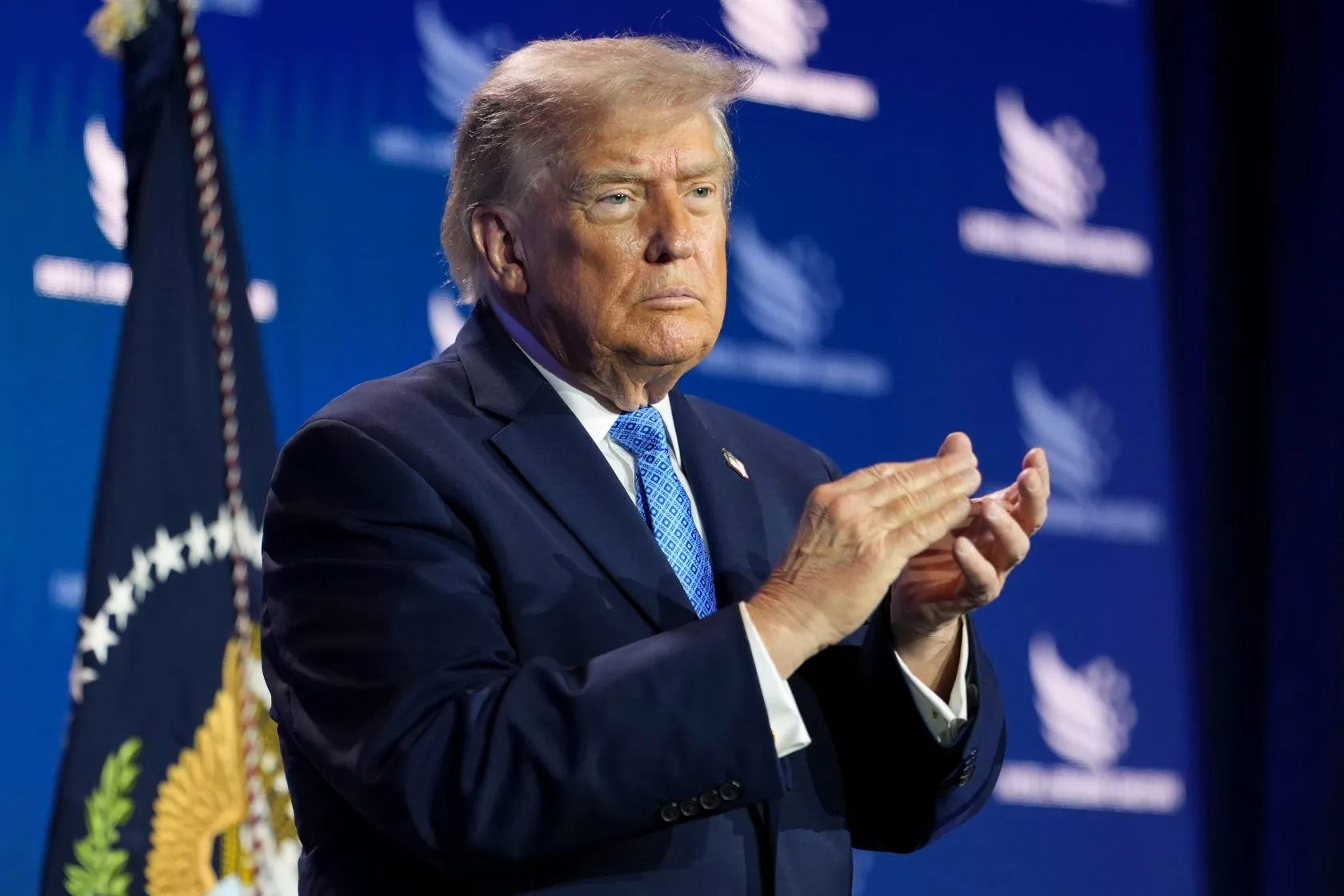
President Donald Trump fired off one of his most aggressive trade threats yet on Friday — a sweeping 100% tariff on all goods from any country that dares impose a Digital Services Tax (DST) on American companies. The announcement, made via Truth Social, landed like a grenade in Brussels, London, and Paris — less than 24 hours after EU member states ratified a landmark trade agreement with the United States.
If it sticks, this threat could reshape transatlantic commerce, destabilize recently negotiated trade deals, and send shockwaves across sectors from luxury goods to automobiles.
What Trump Actually Said
In a blunt Truth Social post, Trump called out European nations by name, warning that several are on the verge of implementing digital taxes targeting US companies.
Key points from his post:
- Any country that imposes a DST will face an immediate 100% tariff on all goods exported to the US
- The tariff will override existing trade deals, whether signed, implemented, or still pending
- He said the action targets countries that are “close to actually doing this”
- European nations were specifically singled out
This is not a hypothetical — the administration has invoked Section 301 of the Trade Act of 1974 as a legal vehicle for retaliatory tariffs, the same mechanism used in earlier trade disputes.
Why It’s Happening Now: The Catalyst
Timing matters. Trump’s threat landed just one day after EU member states gave the green light to a US-EU tariff deal — a deal that caps taxes on European imports at 15%. That deal took months of negotiations to finalize after European Commission chief Ursula von der Leyen brokered a tentative agreement during a meeting at Trump’s Scottish golf resort last year.
But digital services taxation was never part of that deal. And now it’s the fault line threatening to crack the entire framework wide open.
With a July 4, 2026 deadline looming for the US and EU to begin implementing their tariff arrangement, Trump’s move raises serious questions about whether that deal survives intact.
The DST Landscape: Who’s in the Crosshairs?
European nations have been quietly building out a patchwork of Digital Services Taxes for years. Here’s where things stand across the continent:
| Country | DST Rate | Scope |
|---|---|---|
| United Kingdom | 2% | Search engines, social media, online marketplaces |
| France | 3% | Digital advertising, user data, digital interfaces |
| Italy | 3% | Online advertising, digital interfaces |
| Spain | 3% | Online advertising, user data sales |
| Austria | 5% | Online advertising |
| Portugal | 4% | Streaming video services |
| Belgium | 3% | Proposed |
The UK has operated a 2% DST since 2020, targeting revenues from search engines, social media platforms, and online marketplaces. France was the first EU country to introduce a DST back in 2019 — a 3% levy applying to companies with over €750M in global revenue and at least €25M earned in France.
Collectively, EU DST revenues could reach an estimated €37.5 billion by 2026 — nearly 19% of the EU’s entire annual budget. That’s what makes them so hard for European governments to walk away from.
Who Gets Hit: America’s Tech Giants
The taxes are designed to capture revenue from companies that generate massive profits in a country without having a significant physical presence there — and in practice, that means American Big Tech.
The companies most exposed:
- Alphabet (Google) — advertising revenues across Europe
- Meta (Facebook/Instagram) — advertising-driven revenues
- Amazon — marketplace and AWS revenues
- Apple — App Store commissions, services
- Microsoft — cloud and software services
US tech firms collectively pay close to $3 billion annually in digital services taxes across Europe, a number that could double by 2030 if no international agreement is reached. Over 60% of firms liable for DSTs in Spain and Turkey alone are American companies, according to the Tholos Foundation.
The cost doesn’t always stay on corporate balance sheets either. When the UK launched its 2% DST in 2020, Google, Amazon, and Apple each passed the tax directly to advertisers and marketplace sellers — raising fees by an equivalent amount. Meta is following the same playbook in 2026, having recently announced “location fees” matching each country’s DST rate, effective July 1, 2026.
Canada’s Cautionary Tale
Trump has successfully wielded this threat before. Canada had planned to implement its own digital services tax but pulled the plug — scrapping the levy within hours of it taking effect — after Trump threatened to cut off all trade negotiations with Ottawa. That capitulation served as a clear proof of concept for the current approach.
Europe, however, is a different beast entirely. EU nations have collectively expressed reluctance to abandon their digital tax regimes, with several officials arguing the taxes are legitimate revenue tools that bring large multinationals in line with the principle of paying taxes where value is generated.
European Commission trade chief Maros Sefcovic has said he is in regular contact with US Trade Representative Jamieson Greer and Commerce Secretary Howard Lutnick — signalling that talks are ongoing, even if the gap remains wide.
Market & Geopolitical Implications
This threat doesn’t arrive in isolation. Consider the broader context:
- The Trump administration had previously named Accenture, Siemens, DHL, SAP, Capgemini, and Publicis as potential targets for fees and restrictions if the EU continues its regulatory actions against US tech companies
- The EU has already levied hundreds of millions of euros in fines against Apple, Meta, and X under the Digital Markets Act
- Trump’s national security strategy released this year has raised questions about the future of NATO solidarity with European allies
- A Goldman Sachs analysis estimated that a 10% US tariff could reduce EU real GDP by 0.1%–0.2%, with Germany taking the largest hit
If a 100% tariff were enacted on European goods, the impact would be seismic. European goods exports to the US span automobiles, pharmaceuticals, luxury products, food, and chemicals — industries that could face severe economic disruption.
Legal Mechanism & Uncertainty
It remains unclear exactly how Trump would implement the threatened tariffs and which specific legal authority he would use. The administration has signalled a potential Section 301 investigation into DSTs, which would require a formal inquiry process before tariffs could be applied. However, the administration has also moved swiftly and unconventionally on tariffs in other areas.
A key wildcard: In February 2026, the US Supreme Court ruled 6–3 that the International Emergency Economic Powers Act (IEEPA) does not authorize tariffs, limiting some of the president’s broader tariff powers. That ruling has complicated the administration’s tariff playbook, and it’s not clear what legal pathway a DST-specific tariff would follow.
What Happens Next
Markets are watching the July 4 deadline closely. That’s when the EU and US are expected to begin rolling out their 15% tariff deal. Whether DST tensions derail that implementation — or escalate further — is the key question for transatlantic trade in the weeks ahead.
Three scenarios are possible:
- EU blinks: Individual member states quietly pause or modify their DST regimes to avoid triggering the 100% tariff, following Canada’s playbook
- Escalation: EU retaliates with its own countermeasures on US tech firms, triggering a full-blown digital trade war
- Negotiated standoff: Both sides agree to pause DST implementation in exchange for progress on an OECD-level global digital tax framework — the same framework that has been stalled for years
The OECD’s Pillar One framework, which would require large multinationals to pay a portion of taxes in countries where their consumers are located, remains unresolved. The UN is pursuing a separate multilateral tax treaty with a 2027 completion target.
For now, the headline is simple: Trump drew a red line, and European capitals are deciding whether to cross it.
Disclaimer: This publication is entirely for informational and journalistic purposes and does not constitute formal financial, investment, or legal advice. All market investments carry inherent risks of capital loss. Always complete independent due diligence prior to executing equity trades or making investment decisions based on trade policy developments.
Follow TNN for daily financial news and economic news today!
About The Author
