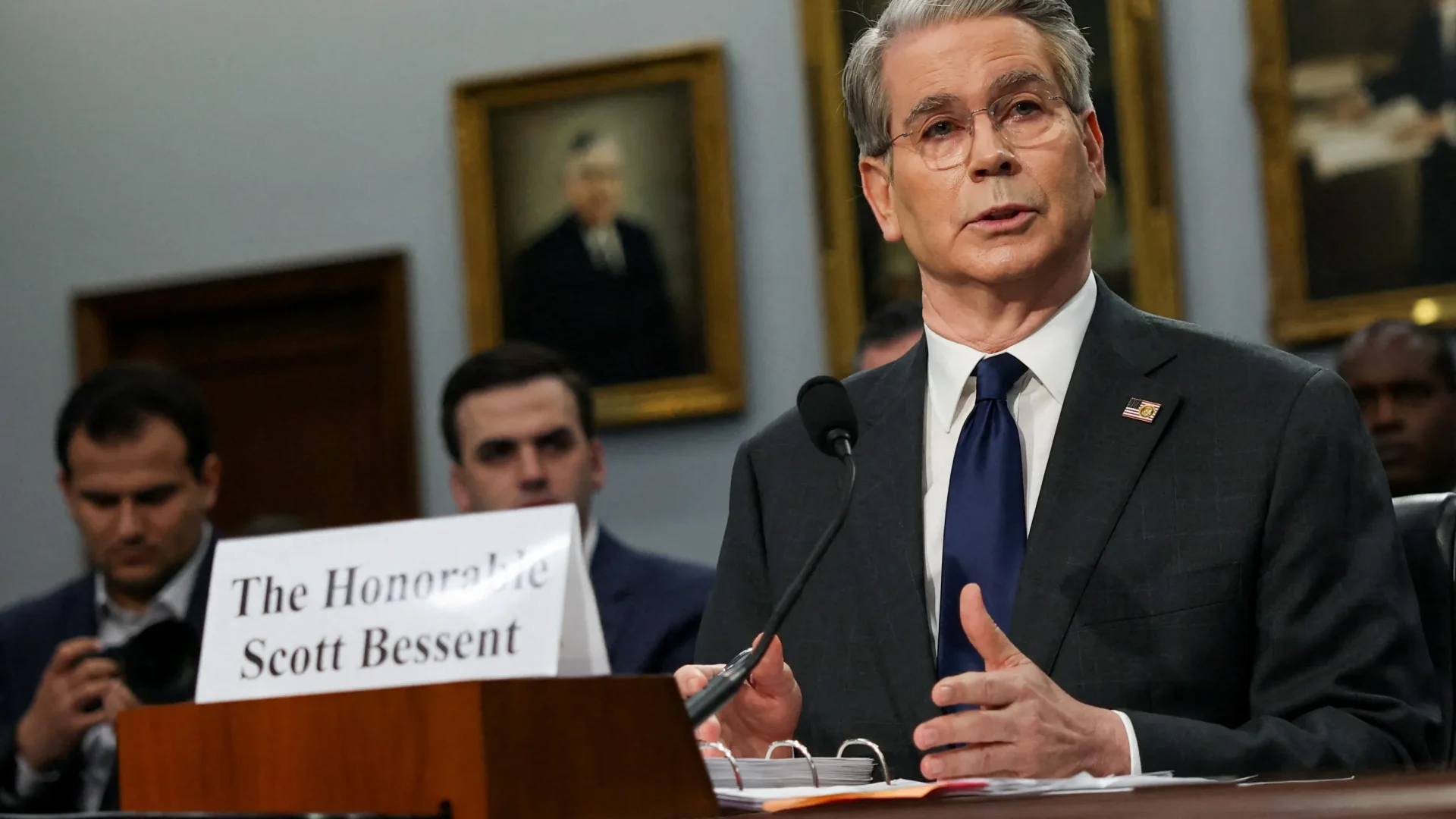
Treasury Secretary Scott Bessent’s promised fiscal fix for America’s debt problem keeps getting pushed further out. What he described in late August as a plan coming “within days” has now become something he’s talking about in “the coming weeks or months” — a quiet but telling shift in language for a debt-reduction package meant to reassure markets increasingly nervous about a $40 trillion national debt. Even when it does arrive, the plan faces a political reality that hasn’t changed at all: a Republican-controlled Congress with no apparent appetite for the kind of spending cuts that would actually move the needle.
Today’s Market Snapshot
- National debt: Recently crossed $40 trillion for the first time.
- Fiscal 2026 deficit: The Congressional Budget Office estimates the federal government will run a $2.1 trillion deficit for the fiscal year ending September 30 — roughly $200 billion more than the prior year.
- Treasury yields: The 10-year yield has risen nearly 70 basis points since the outbreak of the Iran war, recently topping 4.74%, pushing 30-year mortgage rates to around 6.75%.
- Interest costs: The federal government made $963 billion in net interest payments in the first 10 months of fiscal year 2026, according to CBO data — about 15% of all federal spending.
The Timeline Keeps Slipping
Bessent’s messaging on the fiscal plan has shifted noticeably in just the past few weeks. In an interview with CNBC in mid-to-late August, he promised a new plan to address fiscal concerns would be announced “within days.” By late August, Bloomberg was reporting the plan was still “due in the coming days.” Now, in more recent remarks, Bessent has described the effort in far less urgent terms: “As I said last week, two weeks ago, that we are also working, Russ Vought and I are working, on a fiscal consolidation package that we’ll be talking about more in the coming weeks or months.”
That’s a meaningfully longer runway than what markets were initially led to expect, and Bessent himself has acknowledged the process is still being assembled: “It’s going to be a very exciting couple of weeks, a couple of months as we put this together.”
What’s Reportedly in the Plan
Bessent hasn’t released full details, but he’s pointed to several building blocks:
- A “fraud task force” he says could save “hundreds of billions of dollars,” working alongside White House budget director Russ Vought.
- Scrutiny of state-level federal funding, with Bessent suggesting some money “given to the states” is being “frittered away” and could be reduced.
- Renewed tariff revenue, as the administration reworks import duty programs following the Supreme Court’s invalidation of much of the president’s earlier tariff regime.
- Economic growth as the primary debt-reduction mechanism — Bessent has argued that growing GDP. Rather than direct spending cuts, is the main path out of the debt burden. Telling reporters the world is “awash in debt” and that growth is the way out.
Why Congress Isn’t Cooperating
The core obstacle facing Bessent’s plan isn’t technical — it’s political, and it hasn’t budged. Republican lawmakers in both chambers dropped plans earlier in the summer to pursue hundreds of billions of dollars in spending cuts. Largely due to pushback from swing-district GOP members worried about voter backlash ahead of the midterms.
North Carolina Senator Thom Tillis offered a blunt assessment of why: “I don’t see anything on deficits because of the politics.” He added that deficit reduction isn’t “a popular winning issue in the election. Even though it’s the right thing to do.”
Democrats have been even more dismissive. Brendan Boyle, the top-ranking Democrat on the House Budget Committee, called Bessent’s statements “not a serious plan,” pointing to the administration’s own record.
“The Trump Republican tax law last year added more to our national debt than any other single law in American history.”
The Entitlement Problem Nobody Wants to Touch
Bessent has spoken about deficit targets in terms of the deficit-to-GDP ratio. Currently around 6%, according to data compiled by Bloomberg. With Bessent previously stating he wants that figure down into the 3% range. But getting there mathematically requires addressing the programs that actually drive the debt. And so far Bessent hasn’t signaled support for the kind of deep cuts that would be needed:
| Fiscal Lever | Bessent’s Current Position |
|---|---|
| Social Security retirement payments | No signaled support for cuts |
| Medicare | No signaled support for cuts |
| Medicaid | No signaled support for cuts |
| New tax increases (beyond tariffs) | No signaled support |
Even if the administration did embrace politically painful entitlement reform, the GOP’s razor-thin congressional margins would make passage extraordinarily difficult. A dynamic budget analysts have pointed to repeatedly as the central, unresolved tension in any credible U.S. deficit-reduction effort.
A Pattern of Treasury Interventions That Haven’t Fully Landed
The delayed fiscal plan is only the latest in a string of Bessent-driven market interventions this summer, several of which have produced mixed results:
- Debt buybacks: Bessent announced the Treasury would at least double its planned buybacks of longer-dated U.S. debt. Aiming to add liquidity to a “thin” summer market and ease elevated borrowing costs. The initial announcement briefly reversed a bond selloff. But yields climbed again within a day as investors largely shrugged off the move.
- The “Bessent put”: Markets have started using this term to describe the secretary’s willingness to intervene unpredictably in Treasury markets to catch short-sellers off guard. Though analysts caution this approach may not have lasting impact on where yields actually settle a few months out.
- Criticism from market participants: Jefferies’ chief U.S. economist Thomas Simons has publicly criticized aspects of how the buyback announcement itself was handled, while BTG Pactual’s John Fath warned that repeated buyback increases risk being read by markets “as desperation,” adding pointedly that “the bottom line is that deficits are not going away.”
What to Watch Next
- The November 4 quarterly refunding announcement: Wall Street banks including Deutsche Bank, Morgan Stanley, and Citigroup are already war-gaming a potentially bigger shift in Treasury’s borrowing strategy. Including the possibility of cutting long-dated bond sales in favor of bills and shorter-maturity notes.
- Whether “weeks or months” becomes a firmer date: Given the plan has already slipped from “within days” to an open-ended timeframe. Market participants are likely to treat any further delay as a signal about how difficult the underlying policy work. And the politics behind it — actually is.
- Fed Chair Kevin Warsh’s response: Bessent’s aggressive Treasury-market interventions are seen as putting new pressure on the Fed, since shifting more borrowing toward short-term bills increases the government’s sensitivity to interest-rate moves. A dynamic that could complicate the Fed’s own policy calculus in the months ahead.
Sector Sentiment Snapshot
Bond markets have responded to Bessent’s activism with more skepticism than relief. Long bond yields hit 19-year highs before the buyback announcement. And even after that intervention, yields resumed climbing within a day. A pattern that suggests investors see the underlying fiscal trajectory. Not short-term liquidity mechanics, as the real driver of borrowing costs. Until a credible deficit-reduction plan actually materializes and clears Congress, that skepticism is likely to persist regardless of how many additional tools Bessent deploys in the interim.
Follow TNN for daily stock market news and financial news today.
Disclaimer: This publication is entirely for informational and journalistic purposes and does not constitute formal financial, investment, or legal advice. All market investments carry inherent risks of capital loss. Always complete independent due diligence prior to executing equity trades.
About The Author
