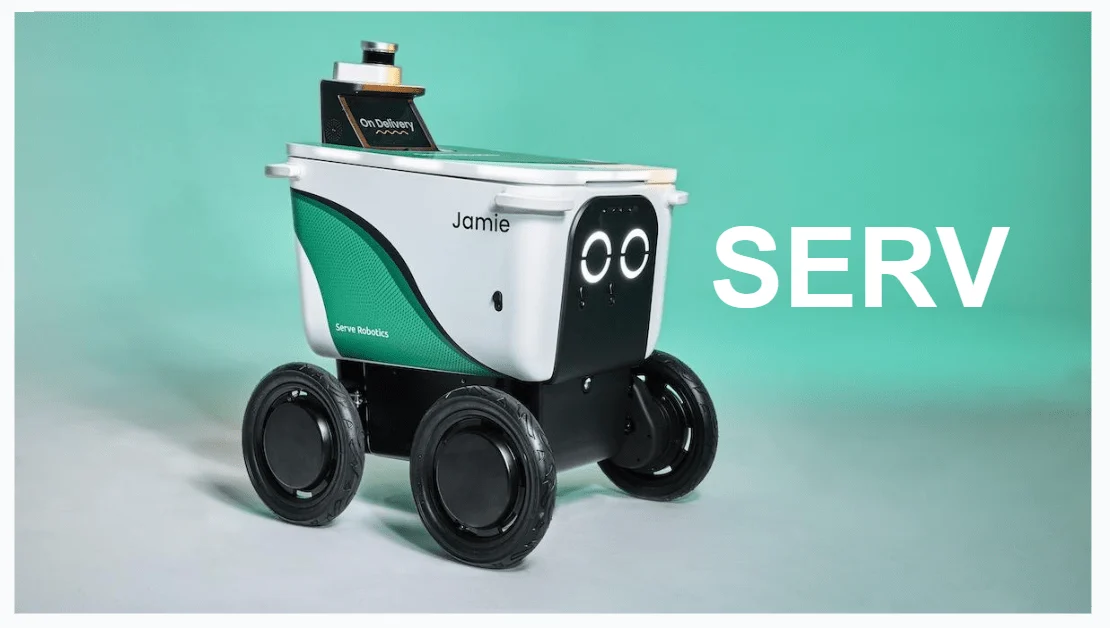
Few small-cap stories in 2026 have been as volatile as Serve Robotics (NASDAQ: SERV). The autonomous sidewalk-delivery company that once traded above $24 a share on hype around robot-powered food delivery has spent the back half of the year fighting to justify its valuation after its single biggest partner and early backer, Uber, exited its equity stake and signaled it won’t renew their delivery agreement. With shares now hovering near $4.69 — down almost 80% from their 2024 peak — the question dominating search traffic and trading desks alike is simple: is this a broken growth story, or a beaten-down robotics play about to turn a corner?
Quick Snapshot (as of September 2, 2026):
| Metric | Value |
|---|---|
| Last Price | $4.69 |
| Recent Daily Move | -3.18% |
| 52-Week High / Low | $18.64 / $4.32 |
| All-Time High (2024) | ~$24.35 |
| Market Cap | ~$400M |
| Shares Outstanding | ~86M |
| YTD Performance | Down ~57–59% |
| 12-Month Performance | Down ~50% |
Serve Robotics Stock Price Today: Full Data Table
Trading & Valuation Snapshot:
| Metric | Value |
|---|---|
| Ticker | NASDAQ: SERV |
| Sector / Industry | Industrials — Integrated Freight & Logistics / Robotics |
| Last Close | $4.69 |
| Day’s Range | Roughly $4.55 – $4.90 |
| 52-Week Range | $4.32 – $18.64 |
| Market Cap | ~$400M (small-cap) |
| P/E Ratio | N/A (unprofitable) |
| Forward Price-to-Sales | ~46x |
| Dividend Yield | N/A |
| Cash & Marketable Securities | $240.4M |
| Next Earnings Date | November 5, 2026 |
Quarterly Financial Snapshot (Q2 2026):
| Metric | Value |
|---|---|
| Q2 2026 Revenue | $3.24M (+404% YoY, +9% sequentially) |
| Q2 2026 Gross Loss | ($8.8M) |
| Q2 2026 Net Loss | ($64.1M) |
| Q2 2026 Adjusted EBITDA | ($44.5M) |
| FY2026 Revenue Guidance | $9M–$10M (slashed from original $26M guide) |
| FY2026 Opex Guidance | $140M–$150M (reduced from $160M–$170M) |
Why Serve Robotics Stock Crashed: The Uber Breakup, Explained
Serve Robotics’ entire investment story was built on its relationship with Uber. Uber spun Serve off in 2021, took an early equity stake alongside Nvidia, and became the delivery platform through which the vast majority of Serve’s robots generated revenue via Uber Eats. That relationship began unraveling in dramatic fashion this summer.
The timeline of the collapse:
- August 6, 2026 — Serve reported Q2 revenue up 404% year-over-year, but management revealed that delivery volume through Uber Eats had declined for the first time in 17 consecutive quarters of growth, driven by disagreements over “fleet coordination, merchant integration, and the overall operating model.”
- August 11, 2026 — Uber’s 13F filing revealed the ride-hailing giant had fully exited its equity stake in Serve Robotics during the second quarter, while simultaneously building new positions in Rivian and Lucid.
- August 18, 2026 — Serve slashed its full-year 2026 revenue guidance to just $9M–$10M, down from an original target of $26M, sending shares tumbling roughly 15% in a single session.
- CEO Ali Kashani confirmed on the earnings call that the company does not currently expect it would make sense to renew the Uber Eats agreement when it expires in early 2027.
The diversification response: Rather than standing still, Serve has moved aggressively to reduce its Uber dependency:
- A new delivery partnership with Grubhub (owned by Wonder), launching in Chicago, Los Angeles, and Alexandria, with over 100 participating merchants in Chicago and nearly 200 in Los Angeles.
- Continued expansion of its DoorDash partnership, which grew revenue nearly 50% sequentially in Q2.
- Launches in Washington, D.C. and San Jose — the company’s seventh and eighth major U.S. markets — plus a first microdepot in Miami.
- Expansion beyond food delivery into healthcare robotics through its acquisition of Diligent Robotics, which makes the Moxi indoor hospital logistics robot — seven multiyear contract extensions and two new hospital customers were signed in the first half of 2026.
- A new pilot delivery partnership with NoScrubs Laundry, signaling ambitions beyond food entirely.
Serve Robotics Stock Chart & Trend: A Boom-and-Bust Story
Serve Robotics went public via a reverse merger in 2023 and spent 2024 as one of the most talked-about momentum stocks in the small-cap robotics space, riding enthusiasm for autonomous delivery and its Nvidia/Uber backing to an all-time high near $24.35. Since then, the stock has been on a punishing downtrend:
| Period | Approx. Price Action |
|---|---|
| 2024 Peak | ~$24.35 (all-time high) |
| Late 2025 | Traded in the $13–$18 range on Buy-rated analyst optimism |
| Early-Mid 2026 | Choppy decline into the high single digits amid broader small-cap AI/robotics volatility |
| August 2026 | Crashed toward 52-week low of $4.32 following Uber exit and guidance cut |
| Current (Sept 2, 2026) | $4.69, attempting to stabilize just above 52-week lows |
The stock is now down close to 80% from its all-time high and roughly 57–59% year-to-date, making it one of the worst-performing names in the robotics and automation sector this year — a group that has otherwise seen pockets of strength in 2026.
Technical Analysis: Key Support and Resistance Levels
Serve Robotics’ technical picture reflects a stock still searching for a bottom rather than one showing signs of a confirmed reversal.
Levels to Watch:
| Level Type | Price | Significance |
|---|---|---|
| Near-Term Support | ~$4.32–$4.55 | 52-week low zone; a break below risks accelerating selling |
| Near-Term Resistance | ~$4.90–$5.00 | Recent accumulated-volume resistance |
| Secondary Resistance | ~$6.60 | Aligns with the 50-day moving average, a level that has repeatedly capped bounces |
| Major Resistance | ~$13.88–$18.00 | Zone where the stock traded through most of late 2025 before the 2026 decline |
Technical Signals:
- The stock has flashed sell signals from both its short- and long-term moving averages, with the 3-month MACD also confirming a bearish signal as of late August 2026.
- RSI readings have oscillated in neutral-to-oversold territory (around the high-40s during recent stabilization attempts), consistent with a stock searching for a floor rather than building fresh upward momentum.
- Bollinger Bands remain unusually wide, reflecting extremely high realized volatility — daily average volatility has run as high as 7%+ in recent weeks, reinforcing SERV’s status as a high-risk, high-beta trade.
Prices to Watch Going Forward: A daily close below $4.32 would open the door to fresh 52-week lows and likely accelerate downside momentum. Conversely, a sustained close above $6.60 — clearing the 50-day moving average — would be the first real technical signal that a bottoming process is underway.
Analyst Price Targets: A Massive Disconnect With the Market
Despite the stock’s collapse, Wall Street analyst price targets remain dramatically higher than where SERV currently trades — though ratings have grown more cautious in recent weeks.
Consensus Analyst Data:
| Metric | Value |
|---|---|
| Number of Analysts | 8 (Wall Street), broader retail-sentiment trackers show more caution |
| Consensus Rating | Buy (per Wall Street desks); some retail-sentiment models show Sell |
| Average Price Target | ~$13.88–$18.43 |
| High Price Target | $22–$27.30 |
| Low Price Target | $7.00–$7.15 |
| Implied Upside (vs. $4.69) | Well over 100% at the average target |
Recent Rating Activity:
- Freedom Broker upgraded SERV to Buy from Hold on August 11, 2026, even as the Uber news broke.
- Oppenheimer initiated coverage with an Outperform rating in December 2025.
- Wedbush has been among the more cautious voices, setting one of the lower targets on the Street.
The wide dispersion between the $7 low-end target and the $22–$27 high-end target underscores just how divided analysts are on whether Serve’s diversification efforts (Grubhub, DoorDash, healthcare robotics) can offset the loss of its founding Uber relationship.
Serve Robotics Stock Forecast 2026 and Beyond: Bull Case vs. Bear Case
The Bull Case
- Diversification is real, not just talk. Grubhub, DoorDash, and healthcare robotics via Diligent give Serve multiple revenue engines instead of a single point of failure — the company now serves eight major U.S. markets.
- Balance sheet strength buys time. With $240.4 million in cash and marketable securities against a reduced 2026 opex plan of $140M–$150M, Serve has meaningful runway to execute its pivot without an imminent capital crisis.
- The unit economics thesis is unchanged. Management continues to argue that Gen 3 robots can cut delivery costs to roughly $1 per order versus $8–$10 for a human driver — a structural cost advantage that, if realized at scale, could support outsized long-term margins.
- Analyst price targets imply enormous upside, and any sign of stabilizing Uber-independent revenue growth could trigger a sharp re-rating from deeply oversold levels.
The Bear Case
- The core growth engine just broke. Losing 17 consecutive quarters of Uber Eats volume growth — and a partner that likely won’t renew its agreement — removes the single largest demand driver the business has had since inception.
- Guidance credibility is damaged. Cutting full-year revenue guidance by roughly 65% (from $26M to $9M–$10M) in a single quarter raises serious questions about management’s forecasting ability and the durability of newer partnerships.
- Losses remain enormous relative to revenue. A $64.1 million quarterly net loss against just $3.24 million in revenue is an extreme mismatch that will require years of flawless execution to close.
- Insider selling has outpaced buying significantly over the trailing 12 months, and only a small percentage of the float is held by insiders — a sentiment headwind for a stock trying to rebuild trust.
- Technical trend remains firmly bearish, with sell signals across multiple moving averages and no confirmed reversal pattern yet in place.
SERV Stock Forecast: What Would Change the Story
For Serve Robotics stock to sustainably recover in 2026 and into 2027, most analysts point to a handful of concrete catalysts:
- Evidence that Grubhub and DoorDash volumes can genuinely replace lost Uber Eats revenue — likely visible in the Q3 2026 print.
- Healthcare robotics traction through Diligent Robotics scaling beyond pilot contracts into a recurring, higher-margin revenue stream.
- A stabilization in cash burn that extends the runway well past the current opex guidance, reducing dilution risk.
- A technical close above the $6.60 resistance zone, which would be the first real signal that selling pressure has genuinely exhausted itself.
Absent those catalysts, the stock is likely to remain a high-volatility, sentiment-driven trade oscillating between its 52-week low near $4.32 and resistance in the $6–$7 range, rather than making a decisive move toward the double-digit price targets analysts currently have on the books.
Bottom Line
Serve Robotics enters the fall of 2026 as a cautionary tale about single-partner concentration risk in the small-cap robotics space, but also as a name with a genuinely diversifying business model and a well-funded balance sheet. The stock’s fate over the next two to three quarters will likely hinge entirely on whether Q3 and Q4 2026 results show real traction from Grubhub, DoorDash, and healthcare robotics — or whether the Uber breakup proves to be a wound the company can’t fully recover from.
Follow TNN for daily stock market news and financial news today.
Disclaimer: This publication is entirely for informational and journalistic purposes and does not constitute formal financial, investment, or legal advice. All market investments carry inherent risks of capital loss, and small-cap, high-volatility stocks like Serve Robotics carry elevated risk. Stock prices, percentage moves, and market data cited reflect figures available at the time of publication and are subject to change as trading continues. Analyst price targets and ratings are third-party estimates and do not guarantee actual results. Always complete independent due diligence prior to executing equity trades.
About The Author
