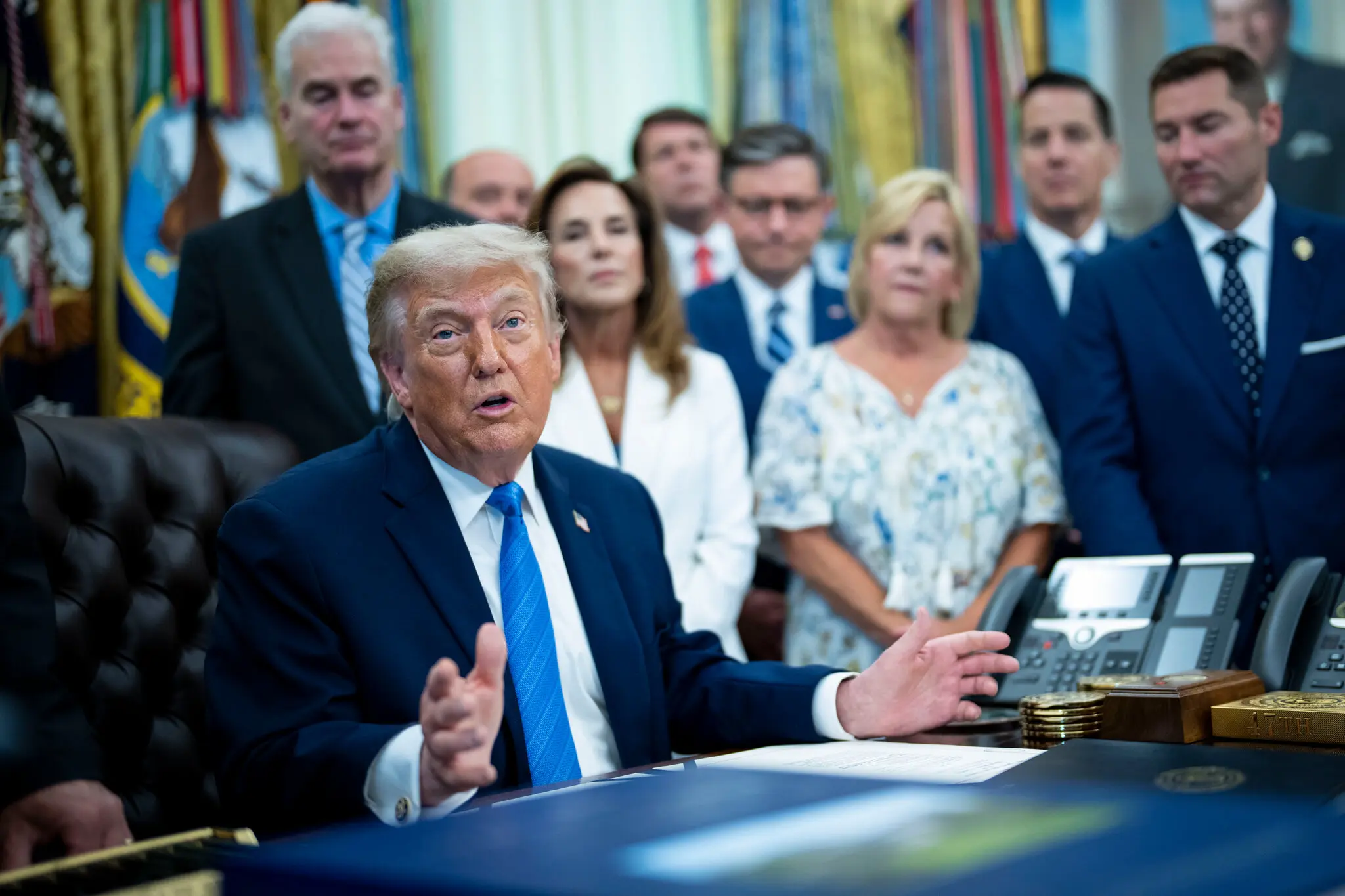
In a move that would have seemed unthinkable five years ago, the Trump administration is in active discussions to have the United States federal government take a direct equity stake in OpenAI — and potentially other frontier AI companies. The idea, which has now been confirmed by President Trump himself, is no longer a fringe policy proposal. It is a live negotiation with the most valuable privately held AI company in the world, backed by bipartisan political interest ranging from the White House to Senator Bernie Sanders, and it raises questions that go to the heart of how America will govern, benefit from, and potentially control the most transformative technology in a generation.
Here is everything that is known — and what it means for investors, the AI industry, and the broader market.
How We Got Here: The Timeline
- February 2025: President Trump signs an executive order directing the Treasury Department and Commerce Department to plan the creation of a U.S. Sovereign Wealth Fund (SWF) — the first serious formal step toward a U.S. government investment vehicle
- Early 2025: OpenAI CEO Sam Altman first pitches the concept of a government equity stake to the Trump administration
- February 2026: Trump orders all federal agencies to “immediately cease” using Anthropic’s technology after the company refuses certain administration requests — effectively drawing a sharp line between the administration’s two most prominent AI relationships
- April 2026: OpenAI publishes a formal policy paper proposing a “Public Wealth Fund” — a nationally managed sovereign investment vehicle seeded by donated equity from AI companies, with proceeds distributed directly to American citizens
- June 1, 2026: Anthropic confidentially files its IPO prospectus with the SEC, putting the company on a path toward public markets
- June 5, 2026: President Trump publicly confirms the discussions, telling reporters he has spoken to AI executives about “concepts where pieces could be given to the American public, where the American public essentially becomes a partner with the companies”
- Week of June 8, 2026: Sam Altman meets with Senator Bernie Sanders in Washington; Sanders introduces the American AI Sovereign Wealth Fund Act, proposing a one-time 50% stock tax on OpenAI, Anthropic, and xAI
The Proposed Structure: A “Public Wealth Fund”
The most detailed proposal currently on the table is OpenAI’s own framework, which is notable for what it avoids as much as what it proposes:
- OpenAI would donate equity to the federal government — not sell it — creating a novel structure that avoids direct taxpayer cash outlays
- The donated shares would seed a Public Wealth Fund managed nationally
- Proceeds from the fund “could be distributed directly to citizens, allowing more people to participate directly in the upside of AI-driven growth, regardless of their starting wealth or access to capital” — OpenAI’s language in its April 2026 policy paper
- The model would mirror, in structure, Alaska’s oil revenue dividend fund — but at the scale of frontier AI
Why OpenAI prefers donation over sale: A donated structure gives OpenAI reputational and regulatory goodwill with the government without triggering an immediate tax event, diluting venture investors through a forced market transaction, or requiring the government to assess and pay for a stake in a company whose fair value is deeply subjective.
The Government’s Existing AI Playbook: It’s Already Happening
This is not as unprecedented as it might appear. The Trump administration has already taken equity positions in several technology companies during the second term:
| Company / Sector | Government Stake Type |
|---|---|
| Intel (INTC) | ~10% stake (struggling chipmaker rescue) |
| IBM | Stake acquired in quantum computing deal |
| Quantum computing companies | Stakes in exchange for federal funding |
| Critical mineral companies | ~20 private companies total |
| Semiconductor companies | Via CHIPS Act renegotiated terms |
The pattern is clear: the Trump administration is willing to take equity as a quid pro quo for government support — and is now signaling it wants to extend that model to AI, where the stakes are far larger.
The financial scale: A 2% stake in a $3 trillion AI company would represent $60 billion in government-held value. OpenAI alone is valued at over $850 billion by private investors following its March 2026 funding round co-led by Abu Dhabi’s sovereign wealth fund MGX. A 1% stake at that valuation = $8.5 billion.
The Sanders Counterproposal: Much More Aggressive
Senator Bernie Sanders, I-VT, proposed the American AI Sovereign Wealth Fund Act — but his version is structurally very different from Trump’s:
- Mechanism: A one-time 50% stock tax on company stock held by OpenAI, Anthropic, and xAI shareholders
- Outcome: Transfers half the equity of industry leaders to the federal government outright
- Governance: The government would obtain voting shares and board representation, with the stated ability to “block decisions that hurt our citizens”
- Distribution: Direct payments to the American people — similar to Trump’s stated vision, but through compulsory seizure rather than voluntary donation
Tech companies are strongly opposed to the Sanders approach. The Trump White House, characteristically, has neither endorsed nor rejected it outright — instead floating the voluntary partnership framework as a moderate middle ground.
The political paradox: Both a democratic socialist senator and the Republican White House are converging on the same underlying idea — that American citizens should own a piece of AI’s upside. The mechanism differs by approximately 180 degrees.
Why Anthropic Is the Odd One Out
One of the most consequential details in this story is what is not happening: Anthropic — the second-largest frontier AI company, valued at $965 billion following a $65 billion funding round — is explicitly not in talks with the administration about providing equity to the government.
- In February 2026, Trump ordered federal agencies to stop using Anthropic’s technology
- A person familiar with the matter confirmed to NOTUS that Anthropic is not participating in these equity discussions
- Anthropic nonetheless filed its IPO prospectus confidentially with the SEC on June 1, 2026 — suggesting it is pursuing a public market path independent of any government deal
The market implication: If OpenAI secures a government equity relationship and Anthropic does not, OpenAI gains preferential access to federal AI contracts, regulatory goodwill, and institutional credibility that Anthropic’s IPO will lack. That asymmetry could meaningfully affect relative valuations when both companies begin trading publicly.
The Critical Unresolved Questions
| Question | Status |
|---|---|
| Will participation be voluntary or compulsory? | Unresolved |
| Will the government seek governance rights (board seats, voting shares)? | Unresolved |
| How is equity valued — at what funding round? | Unresolved |
| Does the model apply only to OpenAI or all frontier AI? | Unresolved |
| What regulatory body oversees the SWF? | No formal proposal yet |
| Does receiving government equity trigger stricter AI regulation? | Unresolved |
| Is this constitutional? (Property and taxation clause questions) | Untested |
The Risks: What Critics and Economists Are Warning
1. Regulatory Conflict of Interest A government that owns equity in an AI company has a financial interest in that company’s success — which fundamentally compromises its ability to regulate the same company impartially. The American Action Forum warned that government-corporate joint enterprises in AI “replace market forces with government dictates.”
2. Too Big to Fail Risk Government equity stakes create implicit backstop guarantees. If OpenAI stumbles financially — a real possibility given its massive compute costs — would a government shareholder allow it to fail? The moral hazard implications are significant.
3. National Security Complexity The U.S. government holding equity in AI companies that develop dual-use technology (civilian and military) creates an uncomfortable intertwining of financial interest, national security oversight, and commercial competition. If OpenAI’s technology is used in adversarial contexts, what is the government’s responsibility as a co-owner?
4. Public Skepticism Fifty-five percent of Americans believe AI will do more harm than good in their day-to-day lives, according to recent Quinnipiac polling. A government-AI ownership structure could amplify concerns that “Washington is handing the future to Silicon Valley,” rather than serving as a check on industry power.
What It Means for AI Investors
For investors watching publicly traded AI-adjacent companies, the equity stake debate has several investable implications:
- OpenAI IPO premium: A government equity relationship could act as a quasi-sovereign endorsement. Lifting OpenAI’s public market valuation relative to Anthropic’s
- AI chipmakers (NVDA, AVGO, AMD): Government AI investment frameworks historically accelerate federal AI procurement. Which flows directly to GPU and AI chip demand
- Defense AI plays (PLTR, BABA, etc.): If the SWF drives federal AI adoption and ownership, defense-AI companies gain from deeper government entanglement in the sector
- The regulatory pendulum: Any governance rights taken by the government create a new regulatory wildcard. A government with board representation at OpenAI is not a neutral regulator of OpenAI’s competitors
The Bottom Line
Washington taking equity stakes in AI companies is no longer a thought experiment. It is an active, documented negotiation between the Trump White House and the most valuable AI company in the world. The mechanism remains unsettled. The politics are strange (a Sanders/Trump overlap). The legal framework is untested. And the regulatory implications are deeply complex.
But the trajectory is clear. The era of AI development as a purely private-sector affair, with government in the role of distant observer, is ending. The question now is not whether the government will own a piece of America’s AI future. But how, and on whose terms.
For investors, the race to understand that answer before it is publicly settled may be one of the most consequential trades of the decade.
Disclaimer: This publication is entirely for informational and journalistic purposes and does not constitute formal financial, investment, or legal advice. All market investments carry inherent risks of capital loss. Always complete independent due diligence prior to executing equity trades. Consult a qualified financial professional before making any investment decisions.
Follow TNN for daily economy news and latest financial news today!
Sources: CNBC Trump-OpenAI Stake, TechCrunch OpenAI Government Stake, MLQ.ai Full Analysis, OpenTools CNBC Summary, NOTUS Senior Officials, Tangle/ReadTangle, American Action Forum, Congress.net.
About The Author
