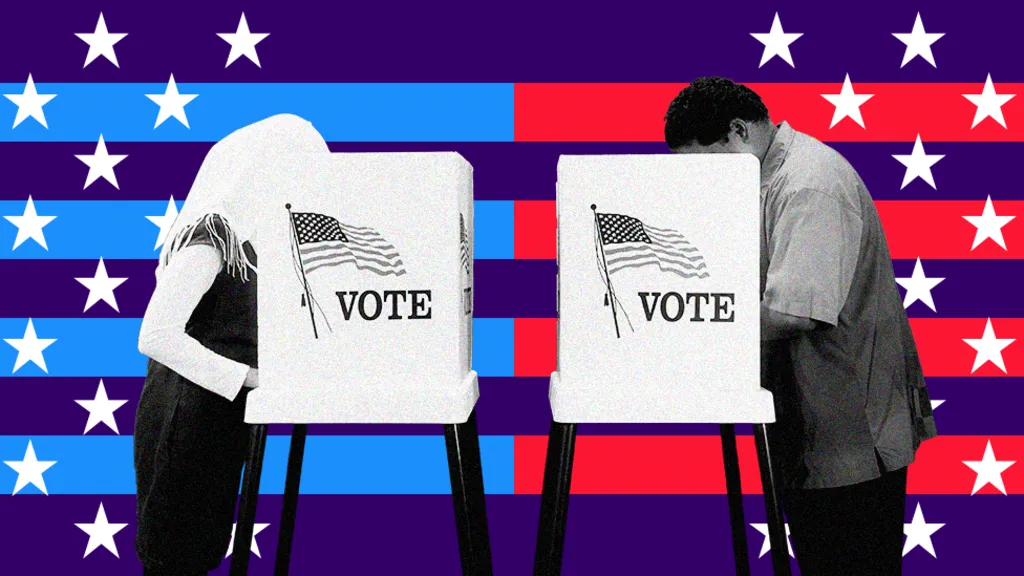
From Primaries to the Presidency — How US Elections Work
If you’re asking how us elections work, this guide walks you through the full process — from early primaries and caucuses to the general election and the Electoral College. Whether you’re a first-time voter or just need a refresher, you’ll learn who runs elections, how candidates are chosen, when people vote, and how the president is ultimately selected.
How US elections work: the big picture
U.S. federal elections operate on two parallel tracks: (1) selecting party nominees through primaries and caucuses, and (2) choosing public officeholders in general elections. For presidential elections, voters cast ballots in a general election every four years; those votes determine which slate of electors represents each state in the Electoral College, which formally elects the president. (USAGov)
Step 1 — Primaries and caucuses: how candidates are chosen
One of the first questions people ask about how us elections work is: how do political parties pick a single nominee? The answer is through a combination of primaries and caucuses. A primary is a state-run election where registered voters cast private ballots for their preferred candidate. Primaries can be open, closed, or semi-closed depending on state rules (open primaries allow unaffiliated voters to participate; closed primaries restrict participation to registered party members). A caucus is a local, often public meeting where party members gather to discuss and choose delegates. The systems differ by state and party. (Encyclopedia Britannica)
Delegates chosen in primaries and caucuses go to the party’s national convention, where the party formally nominates its candidate for president. State rules and party rules determine how to award the delegates — proportionally or winner-take-all in some cases — and that affects campaign strategy and momentum.
Step 2 — The general election: who votes and when
Once parties nominate candidates, the general election decides who will hold the office. For federal offices:
- They select the House members every two years.
- Senators serve six-year terms, with roughly one-third of the Senate up for election every two years.
- The president is elected every four years. (USAGov)
Voter registration, absentee and early voting, and ID requirements vary by state. State and local election offices manage the logistics, while federal laws and agencies (like the FEC for campaign finance) provide rules and oversight. If you plan to vote, check your state’s deadlines and registration requirements well before Election Day. (USAGov)
Step 3 — The Electoral College: how the president is chosen
A distinctive feature of how us elections work is the Electoral College. The Electoral College consists of 538 electors; a candidate must win a majority — at least 270 electoral votes — to become president. Each state’s number of electors equals its total U.S. Senators (always two) plus its Representatives (which vary by population). Most states award their electoral votes on a winner-take-all basis, but Maine and Nebraska use a congressional-district method that can split their electoral votes. (National Archives)
This indirect system means that winning the nationwide popular vote does not automatically guarantee the presidency; the statewide (and in two states, district-level) results determine how electors are pledged.
Common questions about how US elections work
What’s the difference between electors and voters?
Voters cast ballots in their state’s election. Electors are people chosen according to state law — usually party loyalists or officials — who cast the formal Electoral College votes based on the state’s results.
Can someone win the popular vote but lose the presidency?
Yes. Because presidential elections are decided by Electoral College votes, a candidate can win the national popular vote but lose the electoral vote, as has happened in several U.S. elections. The Electoral College design — and its winner-take-all practice in most states — creates this possibility. (National Archives)
Are elections run the same in every state?
No. States administer elections and set many rules: how registration works, whether early voting is allowed, ID requirements, and how primaries are structured. This patchwork explains some of the variation you see around the country. (USAGov)
How citizens can participate in the process
Understanding how us elections work is only useful if you act on it. Here are practical steps:
- Register to vote before your state’s deadline; many states offer online registration or a national form. (USAGov)
- Learn your state’s rules for early voting and absentee ballots.
- Check sample ballots and local candidate information before you vote.
- Volunteer at local polling places, join get-out-the-vote efforts, or observe local politics by attending town halls.
Final notes: rules, transparency, and the role of information
U.S. elections combine local administration with national systems and oversight. Agencies like the Federal Election Commission regulate campaign finance, while state election officials manage the day-to-day mechanics. Debates about reform — from expanding early voting to changing the Electoral College allocation — are perennial. The best approach for voters is to stay informed about state rules and deadlines, and to use official sources (state election websites, USA.gov, National Archives) for accurate guidance. (USAGov)
Follow TNN for latest US NEWS TODAY.
About The Author
